
Youth Action Fund
The Youth Action Fund (YAF) provides funding to grassroots initiatives working with young people who are underserved by the education system and overrepresented in the criminal justice and child welfare systems. YAF prioritizes Black and/or Indigenous youth-led initiatives. This fund was informed by a series of consultations with experts and advocates in the field and our current strategic plan.
Congratulations to the groups that have been approved for funding in 2025.
You can get an overview of their projects by clicking here.
2020
FOR FURTHER INFORMATION
If you have any questions about the program, please get in touch at info@laidlawfdn.org
The fund is closed for 2026
Read Youth Action Fund guidelines for more details & FAQ
Overview +
The Youth Action Fund (YAF), as informed by our Strategic Plan, offers grants to grassroots initiatives working with youth who are underserved by the education system and overrepresented in the justice and child welfare systems. The development of this fund was guided by a series of consultations with experts and advocates in the field.
More specifically, the Youth Action Fund grants are for grassroot initiatives to develop and lead projects where they:
• Elevate priorities and voices of youth with lived experiences in the identified systems
• Promote equitable and accountable institutions and systems
• Advocate for evidence-based policy
• Support initiatives working on, or, advocating for prevention, early intervention, and crisis intervention.
• Support initiatives that are led and informed by Black and/or Indigenous youth with community buy-in
FUNDING CRITERIA +
- Initiatives must be Ontario-based
- Initiatives must demonstrate youth leadership (30 inclusive and under)
- Initiatives by Black and/or Indigenous youth must be led by Black and/or Indigenous youth, respectively
- Initiatives must address issues impacting Black and/or Indigenous youth in at least one of these three systems: Child Welfare, Criminal Justice, and/or Education
- Applicants must be grassroots groups, nonprofits, charities, or First Nations band
Priorities +
Priority will be given, but not limited to:
- Initiatives by and for Black and/or Indigenous youth that have lived experience with at least one or more of these systems: justice, child welfare, and education
- Initiatives that are Black youth-led and/or Indigenous youth-led
- Initiatives that take on a youth-centred approach
- Projects working to combat systemic racism and discrimination presented across all three systems
- Initiatives that connect services and advocacy across all three systems
- Projects that promote or develop better practices for supporting youth disadvantaged by the justice, education and child welfare
- Initiatives that work towards and advocate for systemic changes in at least one of the three systems: child welfare, education, and criminal justice
ELIGIBLE +
Initiatives must be:
• Led and informed by young people supporting youth leadership (30 inclusive and under)
• Ontario-based
• Group should be a Charity, Nonprofit, or Grassroots
• Based within the communities they are serving and/or with a proven history of working with the communities they identify
• Distant programming with First Nations must be welcomed by invitation and/or in partnership with the youth and supported by their community-based allies
GRANT AMOUNT +
The Youth Action Fund provides operating and project grants to organizations and initiatives working in Ontario. Groups can request up to $100,000 per year for up to three years.
Type of Support +
The Youth Action Fund provides operating and project grants to organizations and initiatives working in Ontario. In general, groups can request up to $100,000 per year for up to three years.
Eligible Expenses +
- Salaries, honoraria, stipends
- Transportation, food, childcare and other expenses that make project activities accessible to young people and other stakeholders
- Project materials and small equipment/technology as long as it is directly related to the project administrative costs associated with the project
Ineligible Expenses +
As a general rule, we are unable to fund:
• Fundraising campaigns
• Capital projects
• Direct financial support to for-profit enterprises
• Endowments
• Sponsorship of events and conferences
• Ongoing operating expenses unrelated to the proposed project
• Projects involving partisan political activities
• Projects involving strictly religious purposes or activities
• Projects outside of Ontario
Note: If there are any expenses you would like to include that are outside the eligibility criteria, please let us know and the Grant Committee will review and make a decision.
Applying for Funding & Key Dates +
FAQ +
What types of initiatives can be funded?
Youth Action Fund grants a variety of projects, e.g., policy & advocacy work, programs, and community-based research (research cannot be part of someone’s masters or doctorate degree). Examples of grantees can be found here.
How many Youth Action Fund grants does the Foundation intend to make through the current call for applications?
This depends on the number of eligible applications and the budget that potential grantees need to do this work. On average and during an open call year, over 100 applications are received and around 10 projects are funded.
How much can we request?
You can apply for up to $100,000 per year for a maximum of three years for a maximum total of $300,000.
We need funding to support our core activities, not a project. Can we apply to the Youth Action Fund?
No. We do not provide core funding. However, we fund core operating costs associated with a project if they are directly related to the project.
Do we need to submit audited financial statements?
No. We do not require financial statements to apply to the Youth Action Fund.
Does an organization need to be youth-led to be eligible?
No. However, the project itself needs to be entirely led by youth (30 and under). This can be done by youth staff, youth advisors, youth board members, etc. Youth who make up the group leads will essentially undertake a project on behalf of the organization.
We are a social enterprise / a for-profit business, can we get funded?
No. We do not fund for-profit entities. Additionally, we do not fund initiatives that come with a cost to the participants or activities that could generate profit (e.g., markets with vendors, event fee, program fee, fee for services, etc.)
We’re asking for funds to have our own microgrants program. Could this get funded?
No. We are unable to fund projects that give out microgrants to other participants, as well as fundraising campaigns, capital expenses, for-profit activities and business/social enterprises, endowments, sponsorship of events and conferences, partisan political activities, religious activities, and projects outside of Ontario.
We are a grassroots group, can we apply to receive funds directly?
No. Currently, the Foundation requires non-incorporated grassroots groups to partner with a registered charitable organization to act as a trustee and provide organizational mentorship and administrative support. The Organizational Mentor will receive funds to distribute to the grassroots group. Depending on capacity, one charity can be an OM for one or multiple groups. While we strongly recommend having a partnership agreement between the group and the Organizational Mentor, this is not required to apply.
What is the usual percentage for admin fees, especially if working with an Organizational Mentor? Do we have to factor admin costs into our budget proposal?
The admin fee for grassroots groups generally goes towards the OM and we don't encourage more than 10% of the budget to be allocated to this line item, which you would factor into your budget proposal. For charities, and nonprofits not working with an OM, the admin budget line can be between 10-15%.
Our project benefits Black and/or Indigenous youth but little to no one in our group shares these racial identities, would our application be competitive?
No. We do not fund projects where the “by and for” is not a structural component of the group. Echoing South African disability activists, Laidlaw espouses the “Nothing about us, without us” slogan. Black, Indigenous, and racialized youth know how best to support their own communities. We are not interested in funding projects that parachute into communities and perpetuate a saviour complex.
Which projects will get priority?
Black and Indigenous youth-led groups will be prioritized over non-Black-led and non-Indigenous-led organizations.
Read the Foundation for Black Communities’ definition of a B3 organization (Black-focused, Black-led, and Black-serving) here. Find The Circle’s definition of Indigenous-benefiting, Indigenous-informed, Indigenous Partnerships and Indigenous-led here.
Can we pay ourselves through this grant?
Yes, please! As long as salaries and honoraria only go to youth and no one above 30 gets paid. We strongly recommend paying youth staff at least a living wage within your area. You can find rates as calculated by Living Wage Ontario. Applicants can opt to do salaries or hourly wages for staff and honoraria for participants - whichever method works best for your group.
Am I able to accept a grant if I’m currently on ODSP?
Folks can keep their ODSP benefit while gainfully employed. Earnings are capped at $1,000 per month on top of what you receive from ODSP. In 2022, the ODSP earning cap increased from $200 to $1000 per month. For every dollar earned past the $1,000 cap, ODSP claws back $0.75. After the $1,000/month cap, you are entitled to $10,000 in-kind compensation annually. Visit ontario.ca/page/ontario-disability-support-program. If you have questions regarding programming and ODSP, contact the Program Director.
Will letters of support increase the strength of our application?
We don’t require letters of support, however, providing recent youth testimonials vouching for the initiative could increase the validity of your application. We are more interested in youth validation over institutional validation so providing letters of support from adults/school boards/institutions does not necessarily strengthen applications.
We understand that the Foundation will not fund capital expenditures. Is computer equipment considered to be capital expenditures?
We will not fund capital expenditures for immovable assets (i.e., buildings, furniture, infrastructure, land, etc.). Small equipment including tech equipment relevant to the project could be included in the budget.
What do you mean by youth-led initiatives?
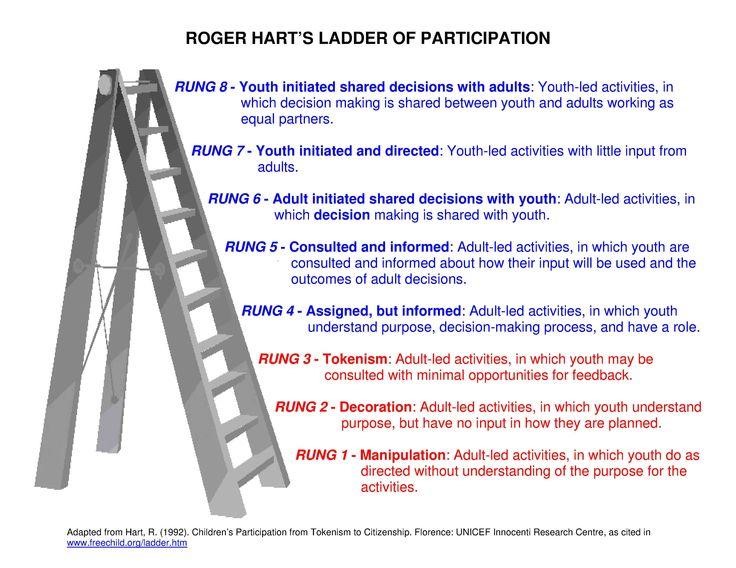
Laidlaw funds projects that are envisioned, developed, led, and implemented by young people (30 and under, at time of application). The image below presents eight levels of youth participation that start from manipulation and tokenism at the lower rungs, to full participation at the top. Youth Action Fund focuses on groups within Rung 7, meaning little to no input from adults - e.g., only paying salaries and honoraria for youth (30 and under), no projects that are adult-directed or ideated where youth only implement or participate, and no projects that don’t have enough Black and Indigenous youth with lived experiences of the system(s).
E.g., A mentorship program where youth will benefit from one-on-one coaching with mentors who will get an honoraria but the mentors are over 30 would not be seen as youth-led as the dynamics become top-down knowledge transfer from adult-to-youth.
What are some common mistakes applicants make when submitting proposals?
Here is a non-exhaustive list of general mistakes people tend to make when applying:
• Forgetting to mention group leads’ lived experience of the system(s), ages, and racial identity
• Parachuting into a community and perpetuating saviourism
• Passion doesn’t come through or has been diluted
• Plan & budget don’t match, no budget line breakdown, or enough details
• Alignment to the system(s) is not strong enough
• Project isn’t youth-led but just youth-serving
• Not reading the FAQs, guidelines, and eligibility criteria
• Non-youth (over 30) write the application and are the only group’s contact
• Youth group leads writing the application don’t attend the info session
We got funding from Laidlaw before, does this affect our new grant application?
Applications are evaluated on merits. Previous Laidlaw funding has no bearing on new applications unless you are a current grantee, and you’re seeking support for the same project and activities. If that’s the case, you’ll need to communicate clearly how your new application will build on your learnings from the previous project.
N.B.: If it comes down to a decision between a project/organization that is currently being funded vs. one that isn’t, reviewers might opt for the one that has not yet gotten a Laidlaw grant.
What do you mean by the justice, child welfare, and education systems?
While justice could be understood as social justice, child welfare as the wellbeing of children, and education as learning - YAF seeks initiatives operating specifically within, or, as an alternative to the legal/criminal, foster care, and education systems. For all three systems, we understand that while some work within institutions, others will seek to offer alternative systems. Both approaches are acceptable.
We understand how youth can have lived experiences in the criminal and child welfare systems. Can you explain what you mean by education?
Projects focusing on education should be by and for Black and Indigenous young people having lived experience with the education system, e.g., being pushed out of the system, being at higher risk of, or already impacted by, streaming, suspensions, detentions, expulsions, lack of access to post-secondary education, etc.
N.B.: YAF seeks projects by and for young people impacted by the education system rather than broader projects seeking to educate or raise awareness.
Can our project focus on multiple regions or does it have to be only one?
Yes. Projects can focus on an individual or multiple regions, neighborhoods, and/or cities within Ontario. All activities and expenses must be conducted in Ontario. Laidlaw is a province-wide funder and cannot fund initiatives outside of ON, partial activities in a different province or region, nor salaries for staff outside of the province.
How do we submit an application?
Submit an application online through Foundant, the Foundation’s online grant management portal. If you have limited access to the internet, you can contact us and request an oral application process or submission via email.
When using the portal, can we leave the application unfinished and return to it later?
Yes. Your application will remain in draft form until you hit submit. You can return to your draft application at any time. Try not to leave the application in draft until the last minute as the system times out.
On deadline day, can we submit our application past deadline time?
No. Foundant times out as soon as the deadline time hits (e.g. 5PM). If you don’t submit before the time, your application will stay in draft and not go through evaluation. There is usually a 30-mins grace period built into the system (e.g., 5:30PM) and due to the volume of applications, making exceptions to submit after the deadline will not be possible.
What happens after we submit an application?
• You will receive an email confirming receipt of application.
• Laidlaw staff review each application for eligibility.
• Strong eligible applications that align well with the Youth Action Fund priorities will be shared with the Granting Committee (GC).
• If we and/or the Granting Committee have follow-up questions about your application, we will reach out.
• The GC reviews shortlisted applications and then meets to consider them. Together, they decide which projects to recommend for funding.
• The GC recommends projects to the Foundation’s Board for ratification.
• Following the Board’s ratification, we will contact you to share decisions made.
How do I learn about the outcome of my application?
After a decision is reached on your application, you will receive an email notification. We do not release results by phone unless you went through an offline application process.
How long will it take to find out the outcome of my application?
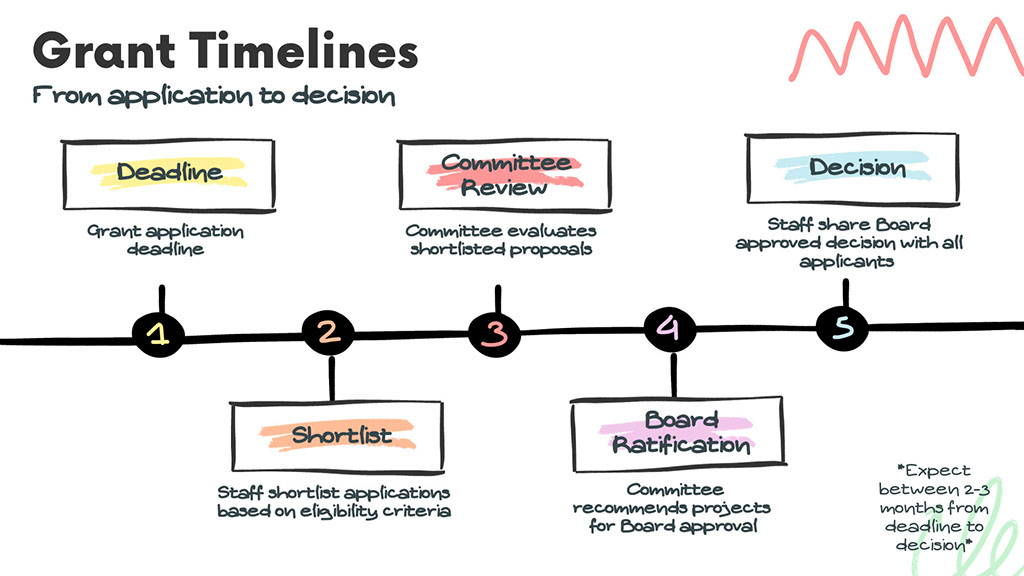
In general, expect 3 months from deadline to decision. Applications go through a series of evaluation:
Our grant application has been approved – what happens next?
Congratulations! You will be asked to review and sign an agreement, which may have special conditions attached that are specific to your grant. Generally, the first installment is paid soon after the receipt of the signed agreement and the remaining installments are paid according to the payment schedule drawn up to suit your particular project.
What is a payment schedule?
A payment schedule outlines dates and grant amounts made to your group by the Foundation for the approved budget. It is developed by taking into consideration the information provided in the work plan, and often also in consultation with the grantee.
Our application did not get accepted. Is there somewhere I can get feedback?
You can contact us directly. We will provide you with feedback on your application based on Granting Committee deliberations.
What happens if COVID-19 impacts my project?
YAF grantees are encouraged to see which activities could be conducted virtually i.e., over Zoom or other similar platforms. We also approve budget reallocations to allow for the purchase of equipment for online communication, where possible.
What adjustments will the Foundation make during the pandemic?
Laidlaw adjusted monitoring of grants and program delivery to reduce additional stress. Funds should still align with the focus of the grant, however, flexibility will be extended for budget reallocation, project deliverables, granting deadlines, and project start dates. If you need to change project plans or make other adjustments to your grant, please reach out to us to discuss.
We have some questions. Who can I contact?
For more information, please contact the Director of Grants & Community Initiatives, Aldeli Albán Reyna, at aalbanreyna@laidlawfdn.org.
2021
See previous YAF cohorts:
Indigenous strategy
We are committed to being more visible and intentional in our work with Indigenous communities and in our efforts to support action on the recommendations from the Truth and Reconciliation Commission. At the core of this Indigenous Strategy, the Foundation’s efforts will:
• Invest in young people and youth-driven groups within an intergenerational framework
• Support cross-cultural learning and understanding of how racism and colonization
continues to shape Indigenous and non-Indigenous relationships
• Commit long-term by carrying the strategy into our next strategic plan
• Be guided by Indigenous priorities and informed by Indigenous communities
LEARN MORE

Indigenous Youth
& Community Futures Fund
Through the Indigenous Youth & Community Futures Fund (IYCFF), we invest in opportunities for Indigenous youth to connect with their land, languages and cultures, and strengthen and deepen their relationships within and across Indigenous communities. We also support the transmission of cultural practices and knowledge to future generations.
Congratulations to the groups that have been approved for funding in 2025.
You can get an overview of their projects by clicking here.
FOR FURTHER INFORMATION
If you have any questions about the program, please get in touch at info@laidlawfdn.org
Laidlaw Foundation will begin accepting applications for the IYCFF on January 19, 2026, with a deadline of March 5, 2026, at 5:00 PM EST.
Please click here to access the grantee portal.
See previous
IYCFF cohorts:
2020
See previous
IYCFF cohorts:
2021
See previous
IYCFF cohorts:
2022
See previous
IYCFF cohorts:
2023
See previous
IYCFF cohorts:
2024
Overview +
Overview of the Fund
Through the Indigenous Youth & Community Futures Fund (IYCFF), we invest in opportunities for Indigenous youth to connect with their land, languages and cultures, and each other. We want to support change-makers to engage in acts of decolonization, nation and community building and cultural resurgence.
Objectives +
More specifically, the IYCFF grants are for Indigenous youth to develop and lead projects where they:
• learn about and are immersed in their lands, languages, rights, laws and cultures
• participate in acts of resurgence, reclamation and cultural care
• build relationships within and across diverse Indigenous communities and nations
• address environmental racism and promote sustainable relationships with the land and water.
Eligibility +
This funding call is open to Indigenous youth-led groups based in remote, rural, and urban territories across Ontario. This means the organization, project leads, and project activities must all be located within Ontario.
A youth-led group is defined as a project developed and led by at least two Indigenous young people, 35 years of age or under. We welcome the involvement of adult allies, community members, Elders, and knowledge keepers in supportive roles, as long as the project idea originates from and is led by Indigenous youth.
We are committed to inclusivity and strongly encourage applications from First Nations, Métis, Inuit, Afro-Indigenous, 2SLGBTQ+, and disabled young people.
Please note that Laidlaw Foundation is able to support grassroots groups. However all successful applicants who are not part of a registered nonprofit, charity, or First Nation band office must partner with an Organizational Mentor (OM) to receive funding. Laidlaw can assist unincorporated groups in finding an OM.
Projects could include:
• Land-based learning opportunities and land stewardship like seed planting, community gardens, harvesting, etc.
• Environmental justice initiatives such as climate action, and Indigenous land and water protection
• Language immersion opportunities
• Culture camps or culture-based education that includes ceremonies, medicines, arts, and sciences
• Social justice, law and rights-based education
• Healing, life promotion and community building
• Other projects that communities deem important to support decolonization reconciliation, nation-building and cultural resurgence
Funding +
You can apply for up to $30,000 for small-scale projects that can last between 6 to 12 months. Please note that due to the number of applications we receive and the limited funds available, grants awarded may be smaller than the amount requested.
If your group was a past 1-year IYCFF grantee, you may apply for a maximum of $30,000 per year for up to two years, for a maximum total of $60,000. However, first-time IYCFF applicants, or those who have not successfully completed a one-year project, may only apply for a one-year grant, with a maximum amount of up to $30,000.
Eligible Expenses +
You can apply for funding to cover:
• Expenses associated with project activities and project materials
• Administrative costs (up to 5%)
• Small equipment and technical costs or fees to carry out the proposed project
• Transportation, food, and childcare expenses for project staff and participants
• Salaries and honorariums for Youth Staff, Elders, Knowledge Keepers and Facilitators
(Please contact us If you’re not sure whether the expenses you anticipate would be eligible for funding or not)
Ineligible Expenses +
As a general rule, we are unable to fund:
• Purchase of land or real estate
• Capital expenses for immovable assets, i.e. buildings
• Fundraising campaigns
• Endowments
• Scholarship and bursaries
• Direct financial support to for-profit enterprises
• Cultural tourism and participating in powwow competitions (as opposed to hosting a powwow)
• Projects involving partisan political activities
• Projects involving strictly religious purposes or activities. Please note that we do not consider Indigenous ceremonies to be religious purposes.
• Salaries for non youth led organization and groups
Applying for Funding & Key Dates +
Laidlaw Foundation will begin accepting applications for IYCFF on January 19, 2026, with a deadline of March 5, 2026 at 5pm EST.
Laidlaw Foundation is hosting a virtual information sessions on the following date:
Tuesday, February 17th at 12:00 PM EST: To register, please click here.
If you were unable to attend the information session you can check out the recording from 2025 by clicking here.
HOW TO APPLY +
To Apply
1. Review the Indigenous Youth and Community Futures Fund Guidelines to determine if you meet the eligibility criteria.
2. Create an account on our online grant management portal to access the application form.
Applicants with Limited Internet Access
Applications are submitted in writing through our online portal; however, if submitting your application through the online portal is not a possibility due to inadequate internet access, please see below for a link to the application in Word.
Here is the link to the Word version of the application.
Please share the completed application to abernard@laidlawfdn.org
ORGANIZATIONAL MENTOR +
An Organizational Mentor (OM) is a charitable organization, nonprofit or First Nation band office that provides support to newly incorporated, unincorporated grassroots groups and youth-led initiatives. This support may include administrative assistance, project mentoring, governance guidance, and financial oversight.
An OM offers more than a transactional role, they can provide ongoing support throughout your project. All OMs must be located in Ontario, Canada. To learn more about OM services, please review our Organizational Mentor Booklet.
FAQ +
Who can apply for grants through the Indigenous Youth Community and Futures Fund?
The IYCFF program supports Indigenous, youth-led groups that are based in traditional territories spanning Ontario. This means the organization, project leads and project activities should be located in Ontario. We acknowledge the hard work of adults, aunties, uncles and other older community members, however the application will be stronger if coming directly from the youth.
What’s an Indigenous, youth-led group?
Young people, who identify as Indigenous Peoples, came up with the project idea and will lead the project with community mentors and/or Elders playing supportive roles as needed and defined by youth. Youth-led is intergenerational, as often there are members older or younger that play important roles in the work. The key thing is that Indigenous, young people under the age of 35 are at the core of decision-making and leadership.
Can an unincorporated group apply for a grant?
We welcome applications from unincorporated groups.
We are a social enterprise/ a for-profit business, can we get funded?
No. We do not fund for profit entities. Additionally, we do not fund initiatives that come with a cost to the participants or activities that could generate profit (e.g., markets with vendors, event fee, program fee, etc.)
Why am I being asked to provide proof of my First Nation/Métis/Inuit Citizenship?
To protect Indigenous grantees and ensure equal access, we require proof of Indigenous identity for the youth leads on the project only. Not everyone involved in the project needs to provide ID.
If you do not have a copy of your status card or Métis membership or Inuit beneficiary card, please upload a letter from your First Nation or community or Indigenous organization confirming your connection.
We understand that the Foundation will not fund capital expenditures. Is computer equipment considered to be capital expenditures?
We will not fund capital expenditures for immovable assets (i.e., buildings, furniture, infrastructure, etc.). Small equipment including tech equipment relevant to the project could be included in the budget.
What are the IYCFF grants designed to support?
The IYCFF grants are for projects that provide opportunities for Indigenous young people to increase or regain access to their culture, land and languages; strengthen and deepen relationship building within and across diverse Indigenous people and communities; address environmental racism and promote sustainable relationships with the land and water and support the transmission of cultural practices and knowledge to future generations. Some examples include Indigenous language projects such as running language immersion classes in the community; land- and culture-based projects for Indigenous youth to increase their knowledge of and access to traditional skills and teachings, such as culture camps organized by Indigenous youth with the support of their community members, Elders and knowledge keepers.
Which projects will get priority?
Projects located in remote areas or northern Ontario will get priority. As well, Indigenous-led organizations will take priority over non-Indigenous-led organizations.
An Indigenous-led organization is defined as having Indigenous identity at the center of the organization’s programming. As well, the majority of the governance structure is held by Indigenous people including their executive, senior and staff level. To read about The Circle’s definition of Indigenous-benefiting, Indigenous-informed, Indigenous Partnerships and Indigenous-led please click here.
What is the amount we can request?
You can apply for up to $30,000 for small-scale, short-term projects that can last between 6 to 12 months. IYCFF applicants that have successfully completed a one year grant can apply for multi-year funding of $30,000 per year for a two year period, totaling up to $60,000.
We need funding to support our core activities, not a project. Can we apply to the Indigenous Youth Fund?
No. We do not provide core funding. However, we fund core operating costs associated with a project if they are directly related to the project.
We’ve already received funding from Laidlaw before. How does this affect our new grant application?
Every application is evaluated on its merits. Previous funding status has no bearing on your new application unless you have an active grant (your project is still going on), and you’re seeking support for the same project and activities. If that’s the case, you’ll be asked to communicate clearly how your new application will be building on your learnings from the previous project.
How do we submit an application?
You can submit an application online or via email or paper mail if you have limited access to the internet. You can also submit an oral, video or powerpoint application. For online submissions, you have to create an account on Foundant, the Foundation’s online grant management portal.
When using the online portal, can we leave the application unfinished and return to it later?
Yes. Your application will remain in draft form until you hit submit. You can return to your draft application at any time.
What happens after we submit an application?
• We’ll send you an email confirming receipt of your application.
• We will review each application and create a shortlist.
• Applications that meet the eligibility criteria and align well with the priorities of the IYCFF program will be shared with Laidlaw’s Indigenous Advisory Committee.
• If we and/or the Indigenous Advisors have follow-up questions about your application, we will let you know.
• The Indigenous Advisors will first conduct individual reviews of the shortlisted applications and then meet in person to consider each application. Advisors will decide together which projects should be recommended for funding and the amount of funding that should be provided.
• The Indigenous Advisors recommend projects to the Foundation’s Board for ratification
• Following the Board’s ratification, we will get in touch with you to share information about the decisions made about your application.
What is the decision-making process? How do you decide which projects to fund?
The IYCFF grants are assessed by an advisory committee made up of Indigenous young people and community members. After reading all grant applications that meet the eligibility criteria and align with the Fund’s priorities, the Indigenous Advisory Committee meets as a group to discuss, score and award grants with the support of the IYCFF Program Director. Projects that are recommended for funding by the Advisory Committee are then forwarded to the Foundation’s Board of Directors for ratification.
How many advisors sit on the Committee?
The Indigenous Advisory Committee currently consists of six individuals. You can read about their work here.
How many Indigenous Youth Fund grants does the Foundation intend to make through the current call for applications?
This depends on the number of eligible applications and the budget that potential grantees need to do this work. We’ve made 24 grants over the past year. You can see the list of approved grants from 2024 here.
How do I learn about the outcome of my application?
After a decision is reached on your application, you will receive an email notification. We do not release results by phone unless you went through an offline application process.
Our grant application has been approved – what happens next?
Congratulations! You will be asked to review and sign an agreement, which may have special conditions attached that are specific to your grant. In general, the first installment is paid soon after the receipt of the signed agreement and remaining installments are paid in accordance with the payment schedule drawn up to suit your particular project.
What is a payment schedule?
A payment schedule outlines the dates and grant amounts made to you by the Foundation for your approved budget. It is developed by taking into consideration the information provided in the work plan, and often also in consultation with the grantee.
Our application did not get accepted. Is there somewhere I can get feedback?
You can contact the IYCFF Program Director. They will provide you with feedback on your application based on the Advisory Committee deliberations.
Am I able to accept a grant if I’m currently on ODSP?
Folks can keep their ODSP benefit while gainfully employed. Earnings are capped at $1,000 per month on top of what you receive from ODSP. In 2022, the ODSP earning cap increased from $200 to $1000 per month. For every dollar earned past the $1,000 cap, ODSP claws back $0.75. After the $1,000/month cap, you are entitled to $10,000 in-kind compensation annually. Visit ontario.ca/page/ontario-disability-support-program. If you have questions regarding programming and ODSP, contact the IYCFF Program Director.
What happens if COVID-19 impacts my project?
safety measures are followed. To get the latest updates and learn more on how to protect yourself and others, please click here. Please reach out to the Laidlaw Program Director if you have any questions.
If there is another lock down, the IYCFF grant recipients are encouraged to look at their project plans and see which activities could be conducted virtually ie. Zoom. The Foundation will also approve the reallocation of budgets to allow for the purchase of equipment for online communication where possible.
What adjustments will the Foundation make during the pandemic?
During these uncertain times, Laidlaw Foundation has made adjustments to the monitoring of grants and program delivery to reduce any additional stress. Funds awarded to Grantees should still align with the focus of the grant, however, flexibility will be extended regarding budget reallocation, project deliverables, granting deadline and project start dates. Should you require changes to your project plans or need to make other adjustments to your grant, please be sure to reach out to us to discuss.
We have some questions. Who can I contact?
For more information, please contact the IYCFF Program Director, Amanda Bernard, at abernard@laidlawfdn.org
black Youth Fund
The Black Youth Fund (BYF), as established in our Strategic Plan 2025-2030, is informed by the Unfunded: Black Communities Overlooked by Canadian Philanthropy report, and the Ontario Nonprofit Network (ONN) 2024 State of the Sector Policy report Built on Hope: Nonprofit Sector Seeking Stability.
FOR FURTHER INFORMATION
If you have any questions about the program, please get in touch at info@laidlawfdn.org
Laidlaw Foundation will begin accepting applications for the BYF on May 20, 2026 with a deadline of June 29, 2026, at 5:00 PM EST.
Please click here to access the grantee portal.
Overview +
Overview of the Fund
The Black Youth Fund (BYF), as established in our Strategic Plan 2025-2030, is informed by the Unfunded: Black Communities Overlooked by Canadian Philanthropy report, and the Ontario Nonprofit Network (ONN) 2024 State of the Sector Policy report Built on Hope: Nonprofit Sector Seeking Stability.
Objectives +
The Black Youth Fund is grounded in a framework based on intersectionality –a legal term coined by Dr. Kimberlé Crenshaw in the late 80s and through the leadership of the Combahee River Collective– as well as critical race theory to confront anti-Black racism. Blackness in Canada is not a monolith and encompasses many Black communities, identities, and experiences including but not limited to Black ancestry, geography, gender, class, sexual orientation, physical ability, nationality, religion, languages spoken, etc.
More specifically, the Black Youth Fund grants are for grassroots initiatives to develop and lead projects where they:
• Amplify voices of Black youth with lived experiences in identified issue areas
• Prioritize Black Queer and Trans youth-led initiatives
• Advocate for Black-led solutions, policy work, and evidence-based research
• Support initiatives working on, or, advocating for prevention, early intervention, and crisis intervention
• Focus on initiatives led and informed by Black youth with community buy-in
Eligibility +
This call is open to Black youth-led groups that are based in remote, rural, and urban areas in Ontario. A youth-led initiative is a project that has been developed by and will be led by at least three Black young people, 35 years of age and under. Youth leads are expected to be the point of contact for the Foundation. Our grant is inclusive of African, Black, Afro-Caribbean, Afro-Indigenous, Afro-Latine, Black Arab, Black Asian, and other racially Black communities. N.B.: People from the Caribbean and African continents (and other predominantly Black areas) who are not racially Black are not eligible for this grant.
Initiatives must be:
• Led and informed by Black young people supporting Black youth leadership (35 inclusive and under)
• Based in Ontario (all group members and expenses must be in the province)
• Proposed by a Charity, Nonprofit, or a Grassroots Group (for-profit entities are not eligible for funding)
• Led by Black youth for by Black youth
• Address issues impacting Black youth in at least one of the BYF issue areas
Black Youth Fund Issue Areas
Identity-Building
• Cultivate a sense of belonging through relationships and community from Black-centric approaches and connect to Black identities, cultures, ancestral knowledge, and practices
Community Organizing
• Support direct action and community mobilization on political and social issues impacting Black youth and their communities
Legal Rights
• Advance legal education and access to legal aid for Black young people and their communities (e.g., housing & tenant rights, rights when protesting, etc.)
Environmental Racism
• Invest in Black youth-led solutions for climate justice
Self-care and Collective Care
• Address need for Black-centred and culturally-safe mental and physical wellbeing
Life Skills Building
• Provide life skills that centre Black cultural practices (e.g., haircare skills for Black youth in care, offer Black-centred spaces for newcomer Black youth)
STEM and Technology
• Advocate for ownership of technology within Black communities and further education in STEM and tech to Black talent (e.g., AI, coding, software development, etc.)
Sports and Community Building
• Teach leadership skills through sports and recreation as a means of engagement and apply a gender lens to ensure Black girls, queer and trans youth are prioritized in sports programming
Economic Development
• Transform financial education beyond literacy, move towards political advocacy to address systems that create conditions for poverty, and support mutual aid and collective care
Mentorship
• Connect Black youth to mentors and networks to combat nepotism, with a particular focus on Northern Ontario and areas with smaller Black populations
Funding +
BYF provides operating and project grants to Black-led initiatives working in Ontario. Groups can request up to $100,000 for a one-time project. The Black Youth Fund has a total of $1 Million to grant out, meaning 10 groups will receive funds.
Eligible Expenses +
You can apply for funding to cover:
• Black youth salaries, honoraria, stipends
• Transportation, food, childcare, Elder honoraria, and other expenses that make project activities accessible to Black young people
• Project materials and small equipment/technology (e.g., laptops, software, camera equipment) directly related to the project’s administrative costs
Ineligible Expenses +
As a general rule, we are unable to fund:
• Fundraising campaigns
• Microgrant projects
• Capital projects
• For-profit enterprises
• Endowments
• Sponsorship of events and conferences
• Ongoing operating expenses unrelated to the proposed project
• Initiatives with a cost to the participants or activities that could generate profits
• Travel outside of Ontario
• Projects outside of Ontario
• Projects involving partisan activities for specific political parties
• Projects involving strictly religious purposes or activities
• Projects from for-profit entities
• Projects that partner with police or other policing institutions (e.g., CAS)
• Projects from organizations with over $1M annual budget
N.B.: Please contact us if you're unsure if expenses would be eligible for funding or not.
Applying for Funding & Key Dates +
HOW TO APPLY +
Review the BYF Guidelines to see if your group meets the eligibility criteria.
Create an account on Foundant, our grant portal, to access the application.
Applicants with Limited Internet Access
Applications are submitted through our online portal; however, if submitting through the online portal is not a possibility due to inadequate internet access, fill out this document and share the completed application to info@laidlawfdn.org.
Oral Submissions
We recognize the significance of oral transmission of stories, histories, lessons and other knowledge to sustain identities for Black communities. In keeping with this, we accept oral submissions. Please get in touch with us to request an oral application process. N.B.: An oral application process means staff will write your application word for word rather than someone offering to finesse your application verbally. The closer to the deadline, the less likely this option will be available as staff capacity will diminish overtime.
Video Submissions
Applicants can submit all or parts of the application via video through the portal under attachments. Make it clear which answers are submitted via video and which questions are written directly in the portal (e.g., write in group leads section “see video for details”).
FAQ +
Black Youth Fund grants a variety of projects, e.g., policy & advocacy work, direct action, programs, and community-based research (research cannot be part of a masters or doctorate degree).
What types of initiatives can be funded?
Black Youth Fund grants a variety of projects, e.g., policy & advocacy work, direct action, programs, and community-based research (research cannot be part of a masters or doctorate degree).
Can our project focus on multiple regions or does it have to be only one?
Yes. Projects can focus on individual or multiple regions, neighbourhoods, cities, and/or province-wide initiatives within Ontario. All activities and expenses must be conducted in Ontario. Laidlaw cannot fund initiatives or travel outside of ON, partial activities in a different province or region, nor salaries for staff outside of the province.
How many Black Youth Fund grants does Laidlaw intend to make through the current call for applications?
While this depends on the number of eligible applications and the budget that potential grantees need to do this work, about 10 groups would receive $100,000. The total pool of funding is $1 Million.
How much can we request?
You can apply for up to $100,000 for a one-time project.
We need funding to support our organization’s core operating expenses/activities, not a project. Can we apply to BYF?
No. We do not provide core funding. However, we fund core operating costs associated with a project, if they are directly related to the project.
Do we need to submit audited financial statements?
No. Laidlaw does not require financial statements to apply to the Black Youth Fund.
Why am I being asked to demonstrate connection to Black communities?
To protect Black grantees and ensure just and meaningful access, Laidlaw operates from a “nothing about us without us” framework. We require that youth leads provide connections to Black community. This can be in the form of photos and/or letters of support from Black-led community organizations to confirm your connection.
Does an organization need to be youth-led to be eligible?
No. However, the project itself needs to be entirely led by Black youth (35 years old and under). This can be done by youth staff, youth advisors, youth board members, etc. Black youth who are group leads will essentially undertake a project on behalf of the organization. Projects should have a minimum of three Black youth leads.
What do you mean by youth-led initiatives?
Laidlaw funds projects envisioned, developed, led, and implemented by Black young people (35 and under, at time of application). The image below presents eight levels of youth participation that start from manipulation and tokenism at the lower rungs, to full participation at the top. Black Youth Fund focuses on groups within Rung 7, meaning little to no input from adults - e.g., only paying salaries and honoraria for youth (35 and under), no projects that are adult-directed or ideated where youth only implement or participate, and no projects that don’t have enough Black youth with lived experiences. Elders are an important part of the ecosystem and can provide guidance and mentorship for the group but not lead the project themselves.
E.g., A mentorship program where youth will benefit from 1:1 coaching with mentors who will get an honoraria but the mentors are over 35 would not be seen as youth-led as the dynamics become top-down knowledge transfer from adult-to-youth.
We are a social enterprise / for-profit business. Can we get funding?
No. We do not fund for-profit entities. Additionally, we do not fund initiatives that come with a cost to the participants or activities that could generate profit (e.g., markets with vendors, event fee, program fee, fee for services, etc.)
We’re asking for funds to have our own microgrants program. Could this get funded?
No. We are unable to fund projects that give out microgrants to other participants, as well as fundraising campaigns, capital expenses, for-profit activities and business/social enterprises, endowments, sponsorship of events and conferences, partisan political activities, religious activities, projects outside of Ontario, and projects that partner with police or other types of policing institutions (e.g., CAS) as it can create unsafe spaces for young people.
We are a grassroots group. Can we apply to receive funds directly?
No. Currently, the Foundation requires non-incorporated grassroots groups to partner with a registered charitable organization or registered nonprofit to act as a trustee and provide organizational mentorship and administrative support. The Organizational Mentor (OM) will receive funds to distribute to the grassroots group. Depending on capacity, one organization can be an OM for one or multiple groups. While we strongly recommend having a partnership agreement between the grassroots group and the OM, this is not required to apply. Laidlaw developed this Organizational Mentor Booklet, which outlines expectations, offers a partner agreement template, and lists Black-led and Indigenous-led organizations that can be contacted.
We are a large charity / registered nonprofit. Do we have to factor admin costs into our budget proposal? What is a Power Imbalance Fee?
For charities and registered nonprofits, the admin budget line can be between 10-15%. To acknowledge the power imbalance that grassroots organizations are in, we require that registered charities and nonprofits with an annual budget of over $1,000,000 provide 10-15% of their proposed budget towards a Black youth-led grassroots group that aligns with the workplan. Due to CRA guidelines, grassroots groups are often forced to partner with larger organizations and release administrative fees. To flip the script, Laidlaw has instituted a Power Imbalance Fee to ensure large organizations who apply to the fund identify small Black youth-led grassroots groups to redistribute unrestricted funds to, which would total 10-15% of the grant amount. This amount should not come with expectations for grassroots groups to do additional labour but rather as a first step in flipping the usual granting power dynamics.
What is the usual percentage for admin fees, especially if working with an Organizational Mentor? Do we have to factor admin costs into our budget proposal?
The admin fee for grassroots groups generally goes towards the OM and we don't encourage more than 10% of the budget to be allocated to this line item, which you would factor into your budget proposal. For charities, and nonprofits not working with an OM, the admin budget line can be between 10-15%.
Our project benefits Black youth but little to no one in our group shares this racial identity, would our application be competitive?
No. We do not fund projects where the “by and for” is not a structural component of the group. Echoing South African disability activists, Laidlaw espouses the “Nothing about us, without us” slogan. Black youth know how best to support their own communities. Laidlaw is not interested in funding projects that parachute into communities and perpetuate a saviour complex.
Which projects will get priority?
Black youth-led groups will be funded over non-Black-led groups. Read the Foundation for Black Communities’ definition of a B3 organization (Black-focused, Black-led, and Black-serving) here.
Can we pay ourselves through this grant?
Absolutely! As long as salaries and honoraria only go to Black youth and no one above 35 gets paid. Projects must pay Black youth staff at least a living wage within your area. Find rates calculated by Living Wage Ontario. If reviewers gauge that the salary / wage is too low, applicants might be asked to rework their budget. Applicants can opt to do salaries or hourly wages for staff and honoraria for participants, whichever method works best for your group. Remember to add Mandatory Employment Related Costs (MERCs) to your wage calculations.
Am I able to accept a grant if I’m currently on ODSP?
Folks can keep their ODSP benefit while gainfully employed. Earnings are capped at $1,000 per month on top of what you receive from ODSP. In 2022, the ODSP earning cap increased from $200 to $1000 per month. For every dollar earned past the $1,000 cap, ODSP claws back $0.75. After the $1,000/month cap, you are entitled to $10,000 in-kind compensation annually. Visit ontario.ca/page/ontario-disability-support-program. If you have questions regarding programming and ODSP, contact the Program Director.
Will letters of support increase the strength of our application?
We don’t require letters of support, however, providing recent youth testimonials vouching for the initiative could increase the validity of your application. We are more interested in Black youth validation over institutional validation so providing letters of support from adults/school boards/institutions does not strengthen applications.
We understand Laidlaw cannot fund capital expenses. Is computer equipment considered capital?
We do not fund capital expenditures for immovable assets (i.e., buildings, furniture, infrastructure, land, etc.). Small equipment including tech equipment relevant to the project could be included in the budget as long as it is not the majority of the budget.
What are some common mistakes applicants make when submitting proposals?
Here is a non-exhaustive list of general mistakes people tend to make when applying:
Forgetting to mention group leads’ lived experience of the system(s), ages, and racial identity
Parachuting into a community and perpetuating saviourism
Passion doesn’t come through or has been diluted
Project plan & budget don’t match, no budget breakdown, or enough details
Alignment to the issue(s) is not strong enough
Project isn’t youth-led but just youth-serving
Not reading the FAQs, guidelines, and eligibility criteria
Non-youth (over 35) write the application and are the only group’s contact
Youth group leads writing the application don’t attend the info session
We got funding from Laidlaw before, does this affect our new grant application?
Applications are evaluated individually. Previous Laidlaw funding has no bearing on new applications unless you are a current grantee, and you’re seeking support for the same project and activities. If that’s the case, you’ll need to communicate clearly how your new application will build on your learnings from the previous project.
N.B.: If it comes down to a decision between a group that is currently being funded vs. one that isn’t, reviewers might opt for one that has not yet gotten a Laidlaw grant.
Can you explain what you mean by environmental racism?
Environmental racism refers to the disproportionate exposure of Black, Indigenous, and racialized communities to polluting industries and environmentally hazardous activities (The Canadian Encyclopedia, 2020). Examples include mercury contamination in Grassy Narrows First Nation, boil water advisory on reserves, resource extraction on Indigenous lands, waste management inequalities, and displacing families and communities. [Black] communities face environmental racism whereby landfills, waste dumps, and other environmentally hazardous activities are disproportionately situated near neighbourhoods of people of African descent, creating serious health risks (Coutinho, A. and Ramesh, H., 2022). Community displacement through renovictions, infrastructure development like the LRT in Little Jamaica, which gentrifies and decimates long-established communities and neighbourhoods.
How do we submit an application?
Submit an application online through Foundant, the Foundation’s online grant portal. If you have limited access to the internet, contact us and request an oral application process or submit via email.
When using the portal, can we leave the application unfinished and return to it later?
Yes. Your application will remain in draft form until you hit submit. You can return to your draft application at any time. Try not to leave the application in draft until the last minute as the system times out.
On deadline day, can we submit our application past deadline time?
No. Foundant times out as soon as the deadline time hits (e.g. 5PM). If you don’t submit before the time, your application will stay in draft mode and not go through evaluation. There is usually a 30-mins grace period built into the system (e.g., 5:30PM) and due to the volume of applications, exceptions to submit after the deadline will not be possible.
What happens after we submit an application?
You will receive an email confirming receipt of application.
Laidlaw staff review each application for eligibility.
Strong eligible applications that align well with the Black Youth Fund priorities will be shared with Black Youth Advisors.
If staff and/or Advisors have follow-up questions, we will reach out.
Advisors review shortlisted applications and then meet to consider them. Together, they decide which projects to recommend for funding.
Advisors recommend projects to the Foundation’s Board for ratification.
Following the Board’s ratification, we will contact you to share decisions made.
How do I learn about the outcome of my application?
After a decision is reached on your application, you will receive an email notification. We do not release results by phone unless you went through an offline application process.
How long will it take to find out the outcome of my application?
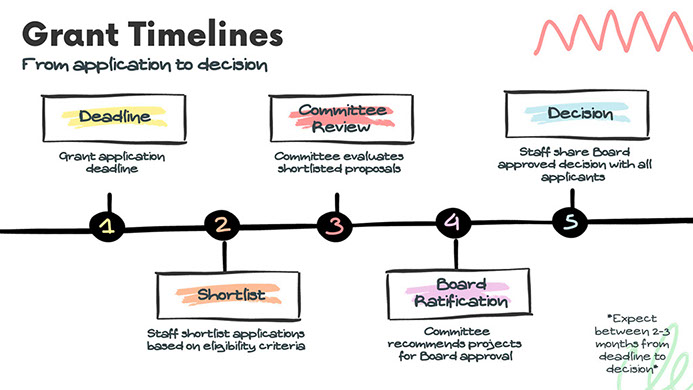
In general, expect at least 3 months from deadline to decision. Applications go through a series of evaluations that coincide with Board meetings for approval:
Our grant application was approved – what happens next?
Congrats! You will review and sign an agreement, which may have special conditions attached that are specific to your grant. Generally, the first installment is paid soon after the receipt of the signed agreement and the remaining installments are paid according to the payment schedule drawn up to suit your particular project.
What is a payment schedule?
A payment schedule outlines dates and grant amounts made to your group by the Foundation for the approved budget. It is developed by taking into consideration the information provided in the work plan, and often also in consultation with the grantee.
Our application did not get accepted. Is there somewhere I can get feedback?
Contact us directly to get feedback based on evaluators’ deliberations.
What happens if COVID-19 or similar pandemics impact my project?
BYF grantees are encouraged to see which activities could be conducted virtually i.e., over Zoom or other similar platforms. We also approve budget reallocations to allow for the purchase of equipment for online communication, where possible.
What adjustments did the Foundation make during the pandemic?
Laidlaw adjusted monitoring of grants and program delivery to alleviate stress. Funds should still align with the grant’s focus, however, flexibility is extended for budget reallocation, project deliverables, granting deadlines, and project start dates. If you need to adjust project plans or make changes to your grant, please reach out to discuss.
Information Sessions & Grant Writing Support
Need support to write your grant application? Access the following resources:
Watch our past Grant Writing 101 recorded webinar
Check our website and register for an upcoming information session
Find in-person info session details on our socials and website
While staff can’t tell you what to apply for, we offer pointers and answer questions more specific to your project idea
We have some more questions. Who can I contact?
For more details, email the Director of Grants & Community Initiatives, Aldeli Albán Reyna, at aalbanreyna@laidlawfdn.org.

Impact Investing
The Global Impact Investing Network defines impact investments as investments made in companies, organizations and funds with the intention to generate social and environmental impact alongside a financial return. The term “impact investing” was coined by the Rockefeller Foundation in 2007, creating a movement and bringing together a community of investors that were already working to address social and environmental challenges through investments that also deliver financial returns. Over a decade later, there has been significant growth in the industry with more individuals and institutions entering the space and large amounts of capital flowing into the market.
LEARN MORE